
On 25 September 2026, Brazil’s National Telecommunications Agency (ANATEL) published Public Consultations No. 41/2026 and No. 42/2026.
The consultations propose new technical and operating requirements for standard-power Wi-Fi devices operating in the 5.925–6.425 GHz band using automatic frequency coordination (AFC).
Key points of the consultation
Public Consultation No. 41/2026
Consultation No. 41 proposes to amend ANATEL Act No. 14.448 (which sets technical requirements for restricted radiation radio equipment) and the related test procedures:
- Establish technical and test requirements for standard-power Wi-Fi devices using AFC
- Specify that devices may operate in the 5.925–6.425 GHz band, subject to the frequency and power levels authorised by the AFC system
- Introduce four concepts:
- Standard Power Access Point
- Fixed Client Device
- Proxy
- AFC System
Public Consultation No. 42/2026
Setting requirements for AFC system operators, including:
- AFC systems must interface with ANATEL’s technical and administrative database (BDTA) and, taking into account the protection requirements of existing systems, dynamically allocate available frequencies and maximum permitted transmit power to devices at specific locations and times;
- The system must support power scheduling from 36 dBm down to a minimum of 21 dBm, with power adjustment steps of no more than 3 dB;
- Define requirements for AFC operators’ qualification registration, system testing, assessment and ongoing operational management.
Power parameters
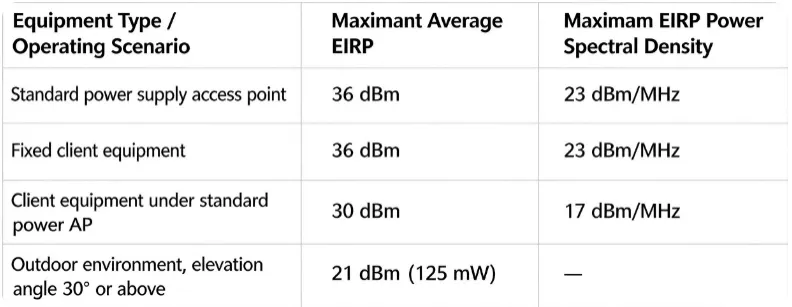
Client devices operating under a standard-power access point must transmit at a level 6 dB below the AFC-authorised EIRP value granted to the corresponding access point.
Related requirements
Outdoor deployment: first-time authorisation with high-elevation power limits
Standard-power Wi-Fi devices will be permitted for outdoor deployment.
When deployed outdoors, devices must limit maximum EIRP to 21 dBm (125 mW) in transmit directions above 30° elevation from the horizon.
AFC mechanism: device operating requirements
- Before activation, the device must complete registration in an ANATEL-authorised AFC system;
- The device may operate only on the frequencies and at the power levels authorised in real time by the AFC system;
- The device must report location coordinates, antenna height, device serial number and ANATEL certification number to the AFC system;
- The device must validate the AFC server’s digital certificate and establish a secure communication link using HTTPS/TLS;
- The device must query status and permissions with the AFC system at least once every 24 hours;
- If AFC communication is interrupted and not restored within the specified period, the device must stop transmitting in standard-power mode;
- Firmware and software tamper-protection mechanisms must be in place to prevent unauthorised modifications that would undermine AFC compliance;
- The device must have positioning capability meeting the required accuracy.
The test procedures will add an AFC Test Harness to simulate AFC system operation and verify device behaviour and AFC compliance.
Impact on Wi-Fi devices
If the proposal is adopted in its current form, future standard-power Wi-Fi access points and fixed client devices applying for ANATEL certification will be subject to additional verification:
- Device AFC functionality
- Secure communication mechanisms (HTTPS/TLS, certificate validation)
- Positioning
- Dynamic power and frequency control capability
- Compliance behaviour after AFC communication loss (silent mode)
Device hardware design, firmware logic and software configuration will fall within the scope of compliance assessment, increasing the number and complexity of certification tests.
Timeline
Public comment period
Deadline: 3 December 2026