
Recently multiple countries have issued new telecom and radio equipment market access rules in quick succession, covering key areas such as radio spectrum planning, type approval requirements, and technical standard updates, with far-reaching implications for electronics and communications exporters.
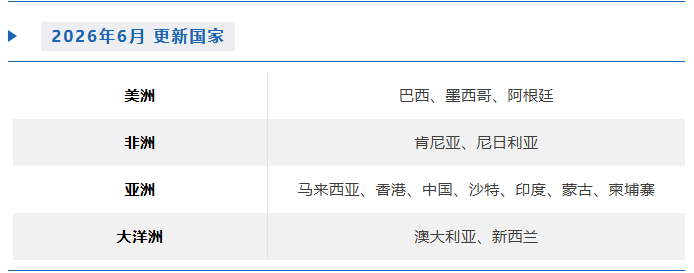
01-Americas
1–Brazil
ANATEL issued Act No. 14158/2025 on October 12, 2025, fully enforced from April 6, 2026
- First definition of “vehicle radar systems”
- Wireless microphones fully adopt the European ETSI EN 300 422-1 V2.2.1 standard
- A brand-new independent conformity assessment category created specifically to regulate multi-channel digital wireless audio equipment in the 54–608 MHz band
- New THz band regulation, opening 4 dedicated sub-bands: 116–123 GHz, 174.8–182 GHz, 185–190 GHz, and 244–246 GHz
- Unified 6 GHz Wi-Fi 6E/7 test methods, based on the FCC’s KDB 789033 document and the IEEE 802.11 series of technical standards
Original text: https://informacoes.anatel.gov.br/legislacao/atos-de-certificacao-de-produtos/2025/2070-ato-14158
2–Mexico
Mexico’s Comisión Radio Television (CRT) published the 2026-2030 National Radio Spectrum Plan on May 18, 2026
- By 2030, Mexico plans to raise commercial IMT spectrum from the current 695 MHz to 1,095 MHz;
- CRT will conduct a national spectrum inventory, coordinate under-utilized bands, and introduce spectrum fee discount policies to encourage operators to fulfill coverage obligations in remote areas.
- Focus on narrowing the urban-rural digital divide, giving priority to the telecom and broadcasting service rights of rural, remote, indigenous, and Afro-Mexican communities
- Establish a regulatory support system for sustainable telecom network construction
- Mexico is committed to modernizing radio spectrum management: it will build a regulatory framework for dynamic spectrum access and sharing, set up regulatory sandboxes to support technological innovation, and upgrade the conformity assessment and approval system for telecom equipment
- Actively participate in ITU and other international forums to keep domestic standards in step with global developments.
3–Argentina
ENACOM Resolution No. 57/2026, issued on February 26, 2026, comes fully into force on September 1, 2026.
- Introduces local third-party approvals recognized by the Argentine OAA; laboratories need IRAM ISO/IEC 17025 accreditation
- Newly registered certificates are permanently valid; Category A consumer devices are audited every two years, Category B is exempt; old certificates are automatically extended to February 26, 2029
- Introduces product-family model certification: similar models may share a certificate
- E-commerce sales of telecom equipment must display the RAMATEL registration number
Original text: https://www.boletinoficial.gob.ar/detalleAviso/primera/338750/20260226
02-Africa
1–Kenya
Short-range devices (SRD) and wireless LAN (WLAN) equipment in the 2.4 GHz/5 GHz bands are now formally required to obtain type approval
Specifically including the following equipment:
- Bluetooth devices: headsets, wearables, wireless sensors
- Smart home / IoT devices: ZigBee/IEEE 802.15.4 devices, smart bulbs, automation sensors
- Computer peripherals: wireless keyboards, wireless mice, wireless adapters
- Remote-control devices: RF remote controls, toy controllers
- Industrial equipment: 2.4 GHz ISM band short-range telemetry devices, industrial sensors
- Specific RFID systems: radio-frequency identification devices operating in the 2.4 GHz band
2–Nigeria
Nigeria’s Communications Commission (NCC) officially published the 2026-2030 spectrum planning roadmap in March 2026
- Low bands (coverage first): 600 MHz for rural 5G coverage, with broadcast user migration and allocation completed in 2026; 700/800 MHz as the wide-coverage mainstay, with spectrum audits and optimization in 2026-2027.
- Mid bands (balanced capacity and coverage): the L band (1427-1518 MHz) allocated in 2026-2027 to support eMBB; 3.3-3.4 GHz migrated and released by the end of 2026; 3.5 GHz auctioned at the end of 2027 adding 200 MHz; 4.8-4.99 GHz evaluated for release in 2026-2030 for 5G/5G-A.
- High bands (mmWave, ultra-high capacity): 26 GHz licensed by the end of 2028 for FWA and enterprise private networks; 38/42 GHz evaluated and prepared for allocation in 2026-2030.
- Licence-exempt bands: the general 2.4/5 GHz bands retained; the lower 6 GHz band opened for Wi-Fi 6E on February 11, 2026; 60 GHz usage guidelines issued in March 2026; the first country in Africa to explicitly designate U6GHz (6425-7125 MHz) as core 5G-A/6G spectrum, with allocation to start in 2028.
03-Asia
1–Malaysia
Malaysia comprehensively tightens the UWB bands; the SRSP standards for the 6425-7725 MHz bands take effect on February 25, 2026
- Only 3700–10600 MHz remains as the sole lawful operating band for UWB
- The 3300–3700 MHz band will be reclaimed and reallocated to other communication services
- All certifications for the old band (3300–3700 MHz) automatically lapse from April 1
The 6425-7725 MHz range is divided into three independent sub-bands, each with its own SRSP standard:
- 6425-7110 MHz, standard SRSP FS 6.425, for fixed wireless access, transport networks, and mobile backhaul
- 7111-7425 MHz, standard SRSP FS 7.111, for point-to-point microwave links and backbone transmission
- 7425-7725 MHz, standard SRSP FS 7.425, for long-haul microwave trunk lines and high-capacity transmission
2-Hong Kong, China
Upgraded 920 MHz band specifications + the 2026 Frequency Allocation Table taking effect in sync
- HKCA 1078 Issue 2: extends coverage to 920–925 MHz public telecom equipment, removes standalone electrical safety clauses, and aligns with the U.S. 47 CFR 15.247 standard
- HKCA 1049 Issue 2: covers RFID equipment in the 865–868 MHz and 920–925 MHz bands, simplifies safety clauses, and upgrades RF technical indicators in sync
- Fully incorporates WRC-23 outcomes, refining service tiers and usage priorities across all bands; the official guidelines become the sole basis for wireless equipment certification, spectrum compliance, and deployment
3–China
The mandatory national standard for power banks GB 47372-2026
- For the first time unifies the regulation of power banks and outdoor power stations, applying to all power bank products with a rated input of 220 V AC or ≤250 V DC.
- Adds nail-penetration testing and lithium-plating checks over 300 cycles; requires real-time battery status monitoring and storage of abnormal-event information; introduces unique-code traceability; clarifies raw material and production requirements.
- A safe service life must be marked; cascade-use (second-life) batteries are banned outright; enclosures must meet V-0 flame retardancy; all ports must have dual protection against short circuit and misoperation.
4–Saudi Arabia
The SASO USB Type-C mandate enters its final enforcement stage
- Mandatory enforcement of the SASO IEC 62680-1-2/3:2023 fast-charge and interface performance standards;
- Test reports are accepted only from ISO/IEC 17025 accredited laboratories; self-declaration is not recognized.
- SASO conducts random inspections of certification files through the SABER system and strengthens customs checks; uncertified or non-compliant products will be returned.
5–India
BIS extends mandatory ISI certification to 90 categories of electrical equipment
- Adopts FMCS (ISI mark) certification; controlled products must carry the mark
- Covers 90+ categories of single-phase ≤250 V and other ≤480 V equipment; DC/battery-powered products are included for the first time
- Mandatory enforcement of IS 302 (Part 1):2024
- General companies enforce from October 1, 2026; small enterprises extended to January 1, 2027; micro enterprises extended to April 1, 2027.
6–Mongolia
On February 13, 2026, Mongolia’s Communications Regulatory Commission (CRC) formally implemented the “Regulations on Certification of Information and Communication Technology Equipment” approved by CRC Resolution No. 24 of 2026
- Removes the age limit on test reports; if the product is unchanged, the report remains valid indefinitely;
- Scheme division: low-risk imported devices follow Scheme 1a (4-year validity); medium-high risk, domestic, and special-purpose devices follow the other three schemes (all 3-year validity).
- Radio, ICT, telecom terminal equipment, and accessories are mandatory certification categories; other devices may be certified voluntarily.
- Equipment must conform to local band and RF, EMC, and electrical safety standards, and certified products must display the CRC certification mark.
- Foreign manufacturers must appoint a local organization as their representative; after the first year of validity, certificates undergo sampling audits annually, with joint market and customs inspections; uncertified devices are barred from circulation.
- Transition period: until September 26, old certificates remain valid; products with no changes are exempt from re-testing when converting certificates; after expiry, the new certification system applies uniformly.
- Unlicensed sales, falsification, failed audits, and similar conduct will be penalized with fines, product confiscation, certificate revocation, and application restrictions.
Original text of CRC Resolution No. 24: https://legalinfo.mn/mn/detail?lawId=17435913766732
7–Cambodia
New 2026 telecom certification rules from Cambodia’s Telecommunication Regulator (TRC) are about to land
- Only locally qualified agents approved by the TRC may apply for certification; foreign manufacturers may not apply directly and must entrust an application to one of them.
- Equipment is classified into risk categories A/B/C; multi-function devices are judged by the highest risk;
- Certified products must affix the TRC compliance label to the outer packaging or embed it via a QR code; the official system allows online verification of compliance status.
- New certificates change from permanent validity to 5 years, with renewal applications submitted 30 days before expiry; old certificates must be reissued within 5 years of the new rules taking effect.
Original text of the TRC draft regulatory framework: https://www.trc.gov.kh/en/media/news-releases/15-news-release
04- Oceania
1–Australia and New Zealand
Australia and New Zealand jointly publish the AS/NZS 61439.2:2026 standard
- Revised on the basis of IEC 61439-2:2020 Edition 3.0, retaining a small number of local variants and unifying safety, manufacturing, and testing requirements
- Main busbars allow a 105℃ temperature-rise environment, increasing current-carrying capacity;
- Three equivalent verification methods replace the traditional TTA/PTTA classification;