
Global Market Access News — September 2026
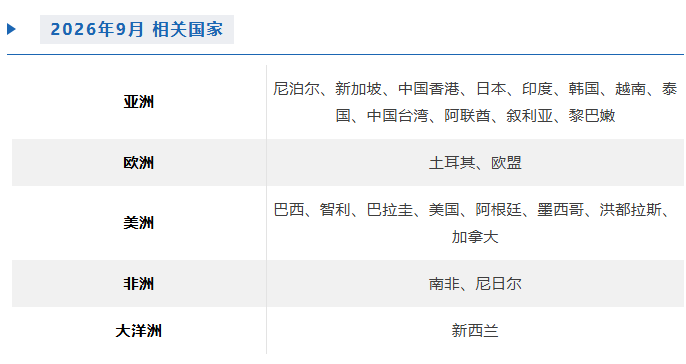
01 — Asia
Nepal
July 15, 2026
Nepal’s Telecommunications Authority (NTA) resumes issuing voluntary exemption letters for specific inbound radio equipment
- The exemption letters were previously suspended and are now formally accepted again.
- Manufacturers may apply for this official exemption document for dedicated radio products other than standard Bluetooth, Wi-Fi, and wireless WAN (WWAN).
Source of the announcement:
Singapore
August 12, 2026
Singapore’s Infocomm Media Development Authority (IMDA) published a brand-new technical specification for eUICC subscription management, with two separate compliance paths for eSIM devices
- Splits consumer-grade devices and M2M IoT-grade devices into two independent technical paths; the two remote SIM provisioning architectures are not interoperable.
- Terminals with eSIM functionality must first confirm their product architecture category, then prepare registration materials against the corresponding standard; the compliance paths cannot be mixed.
- An eUICC subscription management infrastructure specification was published alongside, clarifying the supporting technical requirements.
- The new standard applies to newly submitted device registration applications, with no mandatory retroactive deadline
Original announcement:
Hong Kong, China
Rules continue in force, reaffirmed by the regulator in 2026
Hong Kong’s Office of the Communications Authority (OFCA) clarifies the spectrum restriction rules for Wi-Fi 6E / Wi-Fi 7 equipment in the 6 GHz band
- Only Wi-Fi 6E and Wi-Fi 7 equipment may operate in the designated 5.925–6.425 GHz band.
- The upper 6.425–7.125 GHz band is completely banned from use in Hong Kong; 6 GHz devices supporting the full band may not be imported for sale directly.
- Access-point class devices (routers, APs, Mesh, repeaters, etc.) require mandatory certification and the CA label; client devices remain under voluntary certification.
- Violations of the Telecommunications Ordinance carry a maximum fine of HK$50,000 and 2 years’ imprisonment.
- The rules remain in effect
Original announcement:
https://www.ofca.gov.hk/sc/consumer_focus/guide/general/smart_choice_of_wi_fi_devices/index.html
Japan
June 1, 2026
Japan’s Ministry of Economy, Trade and Industry (METI) revised the official interpretive document for the technical standards of the Electrical Appliances and Materials Safety Act, updating the technical basis for PSE certification
- Revises the official interpretation of the technical standards under the DENAN/PSE framework and updates the corresponding annex technical requirements in sync.
- Sets a transition period for the designated revised annexes; the previous technical requirements may continue to be used until May 31, 2029.
- Requires manufacturers to re-verify the applicable JIS standards, IEC equivalent standards, and Japanese national deviation clauses.
- Took effect on June 1, 2026, with the designated annex transition period running to May 31, 2029
Original announcement:
https://www.meti.go.jp/policy/consumer/seian/denan/act.html
India
May 22, 2026
India’s Bureau of Indian Standards (BIS) issued the “Guidance on Product Categories under the Compulsory Registration Scheme (CRS)”, clarifying the certification classification of wearable eyewear and XR devices
- Clarifies the BIS CRS mandatory registration classification for wearable eyewear and XR devices.
- Relevant products must be brought into the BIS mandatory registration management system and meet the corresponding standard requirements.
- Effective immediately upon publication
Original text of the regulation and standard:
https://www.crsbis.in/BIS/app_srv/tdc/gl/docs/Guidance_on_product_categories_under_Compulsory_Registration_Scheme_%28CRS%29.pdf
India
June 10, 2026
India’s Department of Telecommunications (DoT) issued a formal notice exempting cellular V2X on-board units in the 5875–5905 MHz band from spectrum licensing requirements
- The exempted band is 5875–5905 MHz (the 5.9 GHz band).
- Applicable equipment: cellular V2X (C-V2X) on-board units (OBU).
- Vehicle manufacturers, parts suppliers, and C-V2X module vendors can directly deploy vehicle-to-vehicle and vehicle-to-infrastructure communication without separate spectrum approval.
- Effective immediately upon publication
Original texts of the regulations and standards:
https://www.dot.gov.in/static/uploads/2026/06/e57098ec9d7015e859c1b98d6e3fadad.pdf
https://mic.mediacdn.vn/document/2026/7/1/tt362026-1782881420543779583110.pdf
South Korea
August 26, 2026
Korea’s Radio Research Agency (RRA) issued a notice formally abolishing two national standards on electromagnetic wave human absorption rate (EMF)
- Abolishes “Test Procedures for Specific Absorption Rate of Mobile Wireless Devices Used at the Ear” (KS C 3370-1).
- Abolishes “Test Procedures for Specific Absorption Rate of Mobile Wireless Devices Used Near the Body” (KS C 3370-2).
- The two standards are replaced by KS C 3350.
- Took effect on August 26, 2026
Original announcement:
https://www.rra.go.kr/ko/notice/noticeList_view.do?nb_seq=6528&cpage=1&nb_type=0&searchCon=&searchTxt=&sortOrder=
Vietnam
July 20, 2026
Vietnam’s Ministry of Science and Technology (MST) issued Circular No. 43/2026/TT-BKHCN, planning FM broadcasting channels and frequency use rules
- Defines the channel division scheme for the 87–108 MHz FM broadcasting band.
- Clarifies the frequency use rules and allocation management requirements for each channel.
- Takes effect on September 5, 2026
Original announcement:
https://mst.gov.vn/van-ban-phap-luat/25474.htm
Thailand
July 28, 2026 (official verbal notice; formal document pending)
Thailand’s National Broadcasting and Telecommunications Commission (NBTC) announced that it accepts ETSI EN 301 893 as the certification test standard for 5.8 GHz WLAN equipment
- WLAN equipment in the 5725–5850 MHz band may use ETSI EN 301 893 test reports to apply for NBTC-SDoC registration, replacing the previously required ETSI EN 302 502.
- Whichever test standard is used, equipment must still meet Thailand’s local maximum 1 W EIRP power limit.
- The standard previously applied to the 5.150–5.725 GHz band; this extends recognition to the 5.8 GHz band.
- Currently confirmed verbally by NBTC officials; the formal written revision is pending
Taiwan, China
June 15, 2026
Taiwan’s Bureau of Standards, Metrology and Inspection (BSMI) announced a proposed revision of the “Inspection Regulations for Power Conversion Systems (PCS) and Photovoltaic Inverters”
- Corrects and updates the inspection regulations for power conversion systems and PV inverters.
- Adjusts the corresponding product testing requirements and certification process in sync.
- At the proposal stage; the effective date is yet to be announced
Original announcement:
https://www.bsmi.gov.tw/wSite/public/Data/f1787018756611.pdf
United Arab Emirates
July 23, 2026
The UAE Ministry of Industry and Advanced Technology (MOIAT) notified the WTO of two drafts proposing mandatory energy-efficiency labelling for monitors, televisions, and electronic display screens
- Products covered: desktop / gaming / professional graphics monitors and the display portion of all-in-ones; televisions and standalone electronic display screens with screen area ≥100 cm². Excluded: projectors, built-in screens of phones/tablets/laptops, medical / industrial / security displays, and VR headsets.
- Uses the EEI energy-efficiency index to grade 1–5 stars; the label must show star rating, EEI, on-mode power consumption, screen size, resolution, model, and a QR code to the national database.
- Requires energy-saving functions such as automatic brightness control, idle standby, and 4-hour automatic shutdown.
- Products with wireless / communication functions must also meet TDRA type approval requirements.
- Comments due: September 21, 2026
Official source:
https://tsims.wto.org/en/Search/SearchByCountry?country=ARE
Syria
September 2, 2026
Syria’s Telecommunications and Postal Regulatory Authority (SY-TPRA) issued Circular No. 21, banning the import of devices supporting only 2G and 3G networks.
Syria’s Telecommunications and Postal Regulatory Authority (SY-TPRA) issued Circular No. 21, announcing that from October 1, 2026, import licenses will no longer be issued for devices supporting only 2G and/or 3G networks.
Official source:
Lebanon
September 2, 2026
Lebanon’s Telecommunications Regulatory Authority (TRA) issued notice TRA/PRE/327-020926, clarifying the relationship between type approval applications and product import and the manufacturer
- Applicant: type approval applications must be submitted in the manufacturer’s name, either by the manufacturer directly or by its authorized representative;
- Certificate effect: certificates are issued in the manufacturer’s name for specific models; any importer of products of the same approved model may reuse the certificate directly for import, with no separate application per importer;
- Scope: standalone equipment, embedded components, corresponding spare parts, etc.
Official source:
https://gma.caict.ac.cn/uploads/update/TRA_clarification-of-type-approval-procedure-for-telecom-enabled-equipment.pdf
02 — Europe
Türkiye
July 11, 2026
Türkiye’s Ministry of Trade published an official gazette update to the import control list for products requiring the CE mark
- Revises the “Import Control Table for Products Requiring the CE Mark”, adjusting the catalog of controlled products.
- Adds entries such as products with motion detection functions; imports of the corresponding products must carry a valid CE mark.
- Non-compliant products will not clear Turkish customs.
- Effective immediately upon publication
Original announcement:
https://www.resmigazete.gov.tr/eskiler/2026/07/20260711-54.htm
European Union
August 2026
The European Telecommunications Standards Institute (ETSI) published several new technical standards
- ETSI EN 319 412-2 V2.5.1: electronic signature and trust infrastructure standard, updating natural-person certificate profile requirements.
- ETSI EN 301 406-1 V3.2.1: Digital Enhanced Cordless Telecommunications (DECT) spectrum harmonization standard, updating the DECT, DECT Evolution, and ULE ultra-low-energy technical specifications.
- Aligns in sync with the technical requirement updates of the EU Radio Equipment Directive (RED).
- Effective immediately upon publication
Official source:
https://www.etsi.org/deliver/etsi_en
European Union
September 4, 2026
The European Commission issued Decision (EU) 2026/2003, comprehensively revising the list of harmonized standards under the Radio Equipment Directive (RED).
Covering equipment categories such as electromagnetic radiation, fixed wireless links, UWB, radar, and base station EMC
Version upgrades of existing standards
- EMF standards: EN 50566:2017/A1:2023, EN 50566:2017/A2:2025 (to be used together with EN 50566:2017);
- Point-to-point fixed wireless link RF standard: EN 302 217-2 V3.4.1;
- UWB tank level probing radar standard: EN 302 372 V3.1.1;
- Maritime and port surveillance radar standard: EN 303 135 V2.2.1;
- Broadcast TV receiver amplifiers and active antenna standard: EN 303 354 V1.2.1.
Newly added harmonized standards
- Short-range devices: EN 300 440-2 V3.1.1, EN 305 550-5 V1.1.1;
- EMC: PMR/TETRA EMC standard EN 301 489-5 V2.3.1, CB equipment EMC standard EN 301 489-13 V2.1.1, cellular base station EMC standard EN 301 489-50 V2.4.1;
- UWB: automotive UWB EN 302 065-3-3 V3.1.0, material sensing UWB EN 302 065-4-4 V2.1.1;
- Radar: primary surveillance radar standard EN 303 364-1-1 V1.1.1.
The mandatory implementation date of the decision is March 7, 2028
Official source:
https://eur-lex.europa.eu/eli/dec_impl/2026/2003/oj
03 — Americas
Brazil
Issued July 6, 2026, published in the official gazette on July 13
Brazil’s National Telecommunications Agency (ANATEL) issued Resolution No. 789, approving the “Brazilian Plan of Allocation, Use, and Distribution of Frequency Bands”
- Formally approves the new edition of the national plan of allocation, use, and distribution of frequency bands (PDFF).
- Revises in parallel the “Regulation on FM Broadcasting Channels and Conditions of Use of the Broadcasting Service and Ancillary Services” (RCC-SRA).
- Reorganizes the spectrum allocation rules across all bands, aligning international spectrum planning with domestic service needs.
- Effective immediately upon publication
Original text of the act:
https://informacoes.anatel.gov.br/legislacao/resolucoes/2026/2157-resolucao-anatel-789
Chile
June 17, 2026
Chile’s telecom regulator SUBTEL issued Exemption Resolution No. 1.247, re-establishing the technical specification for low-power / short-range radio equipment
- Updates the technical specifications and access requirements for low-power / short-range devices (SRD).
- Adjusts the bands, power, and compliance testing rules for the corresponding equipment, aligning with international standard updates.
- Effective immediately upon publication
Original text of the act:
https://www.bcn.cl/leychile/navegar?i=1109333&utm_source=chatgpt.com
Paraguay
June 30, 2026
Paraguay’s National Telecommunications Commission (CONATEL) issued Directorial Resolution No. 1232-2026, updating the “National Frequency Plan”
- Updates the national radio frequency allocation and use planning, covering band allocation across services.
- Aligns with ITU spectrum planning requirements and adapts to the deployment needs of new technologies such as 5G.
- Effective immediately upon publication
Original text of the act:
https://www.conatel.gov.py/resolucion-directorio-n-1232-2026
United States
August 20, 2026
The U.S. Federal Communications Commission (FCC) issued Public Notice DA 26-870, revising the rules for foreign-produced power inverters on the controlled list.
- Scope of control: only UL1741 utility-interactive grid-tied inverters; off-grid inverters and pure rectifier equipment are no longer controlled.
- Expanded definition of connected: beyond factory-installed communication modules, products with reserved interfaces/slots that can later be fitted with communication components (wired / Wi-Fi / cellular / Bluetooth) are also brought under regulation.
- Exemption conditions (meeting either one removes the product from list control):
- Eligibility for the 26 U.S.C. §45X advanced manufacturing tax credit;
- Compliance with the “Buy American” standard: domestic component share above 65% through 2028; above 75% from 2029.
Original text of the act:
https://docs.fcc.gov/public/attachments/DA-26-870A1.pdf
Argentina
August 26, 2026
Argentina’s national communications authority (ENACOM) issued Resolution No. 843/2026.
It extends the implementation deadline of RAMATEL’s new regulatory framework (Resolution No. 57/2026) from September 1, 2026 to December 1, 2026.
Transition arrangements:
- During the transition, telecom equipment registration still follows the current Resolution 729/80 procedure;
- Approved certifications keep their three-year validity unchanged, but when a certificate expires it must conform to the new RAMATEL standards to be renewed.
Original text of the act:
https://www.boletinoficial.gob.ar/detalleAviso/primera/346523/20260828
Mexico
August 28, 2026
Mexico’s telecommunications regulator (CRT) published an amendment to Part 3 of the IFT-011-2022 standard.
Part 3 of IFT-011-2022 concerns the cellular broadcast service agreements for notifications of risk or emergency situations.
- The international standard referenced by the standard is ETSI TS 123 041 V19.3.0 (2026-02).
- For certified equipment with hardware support, the new functionality can be activated through a software upgrade, with a notification submitted to the certification body and inclusion in subsequent annual supervision sampling;
- For older devices that do not support the new functionality, the original certificate remains valid but cannot be extended.
Effective date:
60 calendar days after publication, i.e. October 27, 2026;
Original text of the act:
https://dof.gob.mx/nota_detalle.php?codigo=5797463&fecha=28/08/2026#gsc.tab=0
Honduras
September 2, 2026
Honduras’ National Telecommunications Commission (CONATEL) adopted Resolution No. NR003/26, updating the “National Frequency Allocation Plan”.
It expands the frequency framework for wireless access, mobile networks, and satellite systems.
Main spectrum changes:
- Wi-Fi band expansion: the 5925–6425 MHz band previously used for Wi-Fi 6E/7 is extended to 5925–7125 MHz, aligning with mainstream markets such as the United States;
- 5G bands clarified: the 3300–3800 MHz band uses TDD mode for public mobile communications (IMT/5G); the 3700–4200 MHz band adds a “mobile (except aeronautical mobile) service allocation”;
- Satellite and private networks: the S band (1990–2010 MHz uplink / 2180–2200 MHz downlink) opens satellite mobile services; the 2500–2690 MHz public mobile band allows deployment of dedicated mobile communication systems;
- LEO satellites loosened: in the 10.7–12.7 GHz, 17.3–18.6 GHz, and 19.7–20.2 GHz bands, traditional EPFD limits are relaxed in favor of link-performance-based protection schemes, promoting the development of broadband LEO / non-geostationary satellites.
The resolution takes effect on the date of publication
Original text of the act:
https://files.conatel.gob.hn/4933f6dc-681e-4fa6-92f2-a57f725872a6.pdf
Canada
September 4, 2026
Canada’s Innovation, Science and Economic Development (ISED) issued Notice 2026-DRS0001, updating the testing laboratory technical assessment checklist and introducing the RSS-Gen Issue 6 standard.
Standard changes and transition period:
- The transition period runs to July 30, 2027; during it both old and new checklists may be used, after which the new version is mandatory;
- Low-band test standard change: for 30 MHz to 1 GHz, from the previous ANSI C63.4 to ANSI/USEMCSC C63.25.2;
- High bands unchanged: for 1 GHz to 18 GHz, verification still follows ANSI C63.25.1 or CISPR 16-1-4.
Original text of the act:
04 — Africa
South Africa
July 24, 2026
South Africa’s Independent Communications Authority (ICASA) published the updated “National Radio Frequency Plan 2026”
- Replaces the 2021 edition, covering spectrum allocation across the full 8.3 kHz–3000 GHz range.
- Aligns with the ITU 2024 Radio Regulations, WRC-23 resolutions, the African Telecommunications Union’s AfriSAP, and the Southern African SADC frequency coordination plan.
- Launches the electronic frequency information system EFIS in parallel, supporting online spectrum queries and service processing. Follows the four-year planning update cycle, adapting to the deployment needs of new technologies and services.
- Effective immediately upon publication
Original announcement:
https://www.icasa.org.za/news/2026/icasa-publishes-an-updated-national-radio-frequency-plan-2026
Niger
Public consultation launched on July 18, 2026
Niger’s telecom regulator ARCEP launched the 2027–2029 spectrum reorganization plan, paving the way for 5G commercial use
- The 600 MHz and 700 MHz bands migrate from broadcasting to mobile communication services.
- The 3.5 GHz band is designated as core 5G spectrum resource, supporting future 5G network deployment.
- Existing fixed wireless access (FWA) services are planned to migrate to the 6 GHz band.
- Spectrum migration will be implemented in phases, with a focus on improving mobile network coverage in rural areas.
- Comments due: August 31, 2026
- Implementation period: phased rollout in 2027–2029
Original announcement:
05 — Oceania
New Zealand
Consultation launched on July 25, 2026
New Zealand’s Energy Efficiency and Conservation Authority (EECA) is seeking public comment on regulatory requirements for EV chargers
- For EV chargers with maximum output power above 2.4 kW, it sets requirements for smart functionality and energy-efficiency performance.
- Covers dimensions such as communication interoperability, charging response capability, random delay and ramp-up functions, data collection, overload protection, secure firmware updates, and information labelling.
- Supports grid peak shaving and flexible load management, fitting a renewable-heavy power system.
- Comments due: September 4, 2026
Original announcement: