
Global Market Access News — August 2026
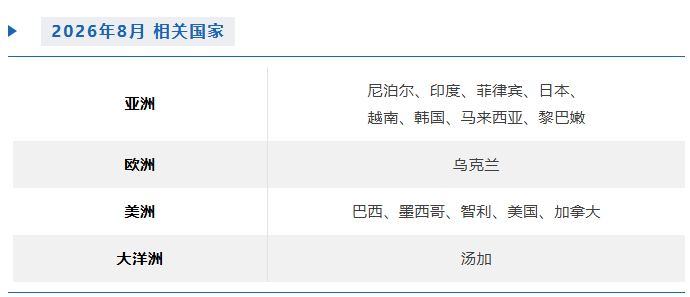
01 — Asia
Nepal
August 10, 2026
The Nepal Telecommunications Authority (NTA) published the draft “Mobile Broadband Enhancement Plan — Nepal’s Path to 5G” for industry comment
Core proposals of the draft
- Phase out 3G networks progressively in 2026.
- Auction spectrum in the 700 MHz, 2300 MHz, 2600 MHz, 3500 MHz, and 26 GHz bands to expand mobile broadband and 5G spectrum resources.
- Promote carrier aggregation, small cells, and fixed wireless access (FWA); upgrade fiber and microwave backhaul networks.
- Improve the network security and data governance framework, set a phased national 5G deployment roadmap, and at the same time lay the groundwork for future 6G readiness.
Comments are due within 15 days of the publication date
Original announcement:
India
July 7, 2026
India’s Teleengineering Centre (TEC) released the draft standard TEC 38020:2026 for Wi-Fi access points for public consultation
- Adds 6 GHz licence-exempt band provisions and Wi-Fi 7 (IEEE 802.11be) technical requirements, covering 320 MHz bandwidth, MLO, 4096-QAM, and other key specifications.
- Recognizes Wi-Fi Alliance certification results: devices holding Wi-Fi CERTIFIED certification are exempt from duplicate TEC testing for items already tested.
- Requires products to meet India’s ITSAR telecom security requirements.
- Updates the referenced EMC and equipment safety standards, adopting the latest IEC and CISPR standards together with India’s TEC 10009:2024 safety specification
Comments are due by September 6, 2026
Original announcement:
https://tec.gov.in/pdf/consultations/Wi-Fi%20Access%20Point%20GR%20for%20public%20consultation.pdf
Philippines
June 29, 2026
The Philippines’ National Telecommunications Commission (NTC) officially issued MC No. 004-06-2026, revising the older MC No. 03-05-2007
- Fully updates the frequency bands and emission power limits for motion-detection and alerting short-range devices (SRD).
- Adds the 77–81 GHz millimeter-wave band for lawful use.
- This band is the mainstream band worldwide for automotive ADAS radar, industrial ranging, and security sensing; its formal adoption finally resolves the previous regulatory ambiguity that made compliant certification for exports to the Philippines impossible.
Original announcement:
https://ntc.gov.ph/wp-content/uploads/2026/MEMORANDUM_CIRCULARS/NTC_MC_No_004-06-2026.pdf
Japan
June 23, 2026
Japan’s Ministry of Internal Affairs and Communications published a regulatory amendment approving outdoor use of 920 MHz beam wireless power transfer systems.
- Removes the restriction that 920 MHz beam wireless power transfer (WPT) systems may be used only indoors
- Equipment meeting the technical and operational management requirements may be deployed outdoors
- Products exported to Japan need Giteki certification for the corresponding outdoor operating conditions; the indoor-version certification cannot be reused directly.
The amendment takes effect on the date of publication
Original announcement:
https://www.kanpo.go.jp/20260623/20260623g00137/20260623g00137full00010160f.html
Vietnam
Vietnam’s Ministry of Science and Technology issued the list of medium- and high-risk products under its control
Vietnam’s Ministry of Industry and Trade issued a circular on traceability management of high-risk products
On June 30, 2026, Vietnam’s Ministry of Science and Technology (MST) officially issued Circular No. 36/2026/TT-BKHCN
- The circular defines the list of medium- and high-risk products under the ministry’s control, listing the corresponding HS codes and quality management requirements.
- Relevant goods produced locally in Vietnam or imported must be certified under QCVN standards or complete a declaration of conformity; imported goods must also pass national quality inspection. The list covers a number of telecom devices.
The document takes effect from July 1, 2026
During 2026, Vietnam’s Ministry of Industry and Trade issued a circular on traceability management of high-risk products
- Traders and importers must complete product identification registration on Vietnam’s official traceability platform and file traceability information;
- Companies that fail to comply will face customs clearance blocks, and their products cannot be placed on the Vietnamese market.
In effect from July 1, 2026, with a transition period ending December 31, 2026.
Original texts of the regulations and standards:
https://mst.gov.vn/van-ban-phap-luat/du-thao/2482.htm
https://mic.mediacdn.vn/document/2026/7/1/tt362026-1782881420543779583110.pdf
South Korea
July 20, 2026
Korea’s Korean Agency for Technology and Standards (KATS) issued a notice of revisions to seven electrical safety standards.
- The revisions cover the KC 60335 series, KC 60081, KC 60969, the KC 61347 series, and more, spanning home appliances, lighting, power supplies, and other product categories
- Companies may complete testing and certificate updates progressively within a one-year transition period
The new rules take effect immediately upon publication; the previous standards may continue to be used in parallel until July 20, 2027
Original announcement:
https://www.kats.go.kr/content.do?cmsid=239&mode=view&page=&cid=26428
Malaysia
July 6, 2026
Malaysia’s Communications and Multimedia Commission (MCMC) issued a notice that it will implement the two technical codes for communications and hybrid equipment published on May 5, 2026.
The two technical codes for communications and hybrid equipment published on May 5, 2026
- “Specification for Short Range Radio Devices (Third Revision)” (MCMC MTSFB TC T007:2026);
- “Baseline Requirements for Communications Equipment” (MCMC MTSFB TC T022:2026).
- Relevant equipment submitted for certification from now on must conform to these two new codes
MCMC provides a six-month grace period; the new rules become fully mandatory from November 5, 2026
Original announcement: https://ecomm.sirim.my/Announcement_Details_New.aspx
Lebanon
To resolve processing delays, Lebanon’s Telecommunications Regulatory Authority (TRA) has issued deferral letters valid for one year, allowing importers to clear customs and import automotive parts without type approval during this period.
- Not automatic: the local importer in Lebanon must proactively apply to the TRA for the exemption letter; it is not granted to all companies automatically.
- Applies only to in-vehicle radio-frequency parts; ordinary mechanical auto parts are not under TRA control, and complete vehicles are not covered by the exemption.
- The exemption lasts only one year; companies should start TRA type approval in parallel, and after it expires customs clearance requires a formal TRA certificate.
- All former MoT certificates are void; the new TRA certificates are valid for two years
02 — Europe
Ukraine
May 6, 2026
Ukraine’s National Commission for Electronic Communications, Radio Frequency Spectrum and Postal Services (NCEC) issued Decision No. 212 approving Wi-Fi 7 technology
- The decision revises the 2025 Decision No. 81 “On approving general conditions for the use of radio equipment or radio installations” and incorporates a reference to the IEEE 802.11be standard (Wi-Fi 7).
- Low-power devices (LPI) with 23 dBm transmit power are permitted for indoor use only;
- Very low-power devices (VLP) at 14 dBm may be used indoors or outdoors.
Official source:
https://zakon.rada.gov.ua/rada/show/v0212897-26#n2
03 — Americas
Brazil
July 10, 2026
Brazil officially published CONAMA Resolution No. 516/2026; Brazil RoHS formally takes effect
August 12, 2026
Brazil’s National Telecommunications Agency (ANATEL) officially issued Act No. 10.400/2026, a major revision of the current technical specification No. 14.448/2017
Brazil officially published CONAMA Resolution No. 516/2026; Brazil RoHS formally takes effect
- It introduces a new hazardous-substances framework for electrical and electronic equipment (EEE); the regulation took effect on its date of publication.
- The regulation sets mandatory limits for ten hazardous substances and establishes a new compliance framework.
Control of the ten hazardous substances will be phased in:
- Immediate: polybrominated biphenyls (PBB) ≤ 0.1%, polybrominated diphenyl ethers (PBDE) ≤ 0.1%;
- After 180 days: mercury (Hg) ≤ 0.1%;
- After three years: cadmium (Cd) ≤ 0.01%, hexavalent chromium (CrVI) ≤ 0.1%, lead (Pb) ≤ 0.1%;
- After four years: di(2-ethylhexyl) phthalate (DEHP) ≤ 0.1%, phthalate (GDP) ≤ 0.1%, dibutyl phthalate (DBP) ≤ 0.1%, diisobutyl phthalate (DIBP) ≤ 0.1%.
Brazil’s National Telecommunications Agency (ANATEL) officially issued Act No. 10.400/2026
- Cuts the Wi-Fi-available spectrum in the 6 GHz band from 5925-7125 MHz (1200 MHz) to 5925-6425 MHz (500 MHz).
- The upper portion, 6425-7125 MHz (700 MHz), will no longer support Wi-Fi/RLAN and is reserved for mobile communication services.
- The act becomes mandatory from March 1, 2027.
This is the first formally implemented 6 GHz spectrum split policy in Latin America, with a direct impact on all manufacturers exporting Wi-Fi 6E and Wi-Fi 7 equipment to Brazil.
Original text of the act:
https://assespropr.org.br/wp-content/uploads/2026/07/RESOLUCAO-CONAMA-No-516-DE-8-DE-JULHO-DE-2026-DOU-Imprensa-Nacional.pdf
Mexico
May 29, 2026
Mexico’s Ministry of Economy (SE) issued an amendment to the General Rules on Foreign Trade, making NOM-001/NOM-024 mandatory for smartphones and other mobile phones
- Smartphones and other mobile phones (HS codes 8517.13.01, 8517.14.91, and 8517.18.99) are no longer eligible for the simplified import compliance exemption. Subsequently, SE confirmed through an SNICE announcement that, from July 1, 2026, these products must demonstrate conformity with the applicable NOM standards upon import, including NOM-001-SCFI-2018 and NOM-024-SCFI-2013.
- SE will launch the new PLATIICA (Plataforma Tecnológica Integral de Infraestructura de la Calidad) platform to manage standardization, metrology, conformity assessment, market surveillance, verification, and related information, services, and administrative procedures.
This agreement took effect on May 30, 2026;
Original text of the act:
https://www.dof.gob.mx/nota_detalle.php?codigo=5788992&fecha=29/05/2026#gsc.tab=0
Chile
July 2, 2026
Chile’s Undersecretariat of Telecommunications (SUBTEL) issued an official resolution revising the fixed satellite service (FSS) technical specification, adding the W band alongside the traditional Ku and Ka bands
- Bringing the W band into the lawful commercial satellite spectrum can significantly increase satellite network bandwidth, transmission rates, and stability, making efficient use of high-frequency spectrum resources.
- Supplementary regulation will be introduced soon to add V-band satellite spectrum, completing the high-frequency satellite communication framework and preparing compliance channels in advance for high-speed satellite services.
Original text of the act:
United States
July 28, 2026
The U.S. Federal Communications Commission (FCC) issued Public Notice DA 26-786, announcing that foreign-produced power inverters and foreign-produced advanced robotics equipment are formally added to the FCC “Covered List”.
- Equipment on the list will be denied FCC equipment authorization and cannot be legally sold or deployed in the U.S. market.
Advanced robotics equipment
Refers to land-mobile mechanical devices, including autonomous mobile, humanoid, and quadruped robots, which must meet all of the following:
- Land mobility with obstacle avoidance and navigation; remote operation via commands or sensor data; total weight of equipment plus ground station/base station over 4.4 lb; equipped with environmental-perception sensors, a network communication module with bidirectional rates of at least 200 kbps, and software (including firmware and AI models) for local/remote control, navigation, and perception.
- Excluded categories: connected vehicles, rail vehicles, drones, underwater unmanned vehicles; medical devices and rehabilitation mobility equipment; fixed non-mobile industrial and medical robots.
Power inverters
- Bidirectional power conversion equipment converting between AC and DC, covering micro, string, central, and storage hybrid inverters;
- Equipped with remote communication, control, sensing, and data-collection monitoring functions over Wi-Fi, cellular, Bluetooth, and the like.
Original text of the act:
https://docs.fcc.gov/public/attachments/DA-26-786A1.pdf
Canada
July 20, 2026
Canada’s Innovation, Science and Economic Development (ISED), via Notice 2025-DRS0006, updated the DFS (Dynamic Frequency Selection) test standard for 5 GHz wireless LAN (RLAN) equipment; the six-month transition period officially ended on July 20, 2026.
- From July 20, 2026, newly certified 5 GHz RLAN equipment in Canada must use ETSI EN 301 893 V2.2.1 for DFS testing; the previous V1.8.1 is retired. The new standard adds terminal radar detection test provisions and improves band interference resilience.
- Under the RSS-247 regulation, it covers wireless equipment across the 902–928 MHz, 2.4 GHz, and 5 GHz bands.
- Conventional bands may accept FCC test solutions; only the new ETSI standard is recognized for the 5600–5650 MHz band, the category most affected by the new rule.
Original text of the act:
https://ised-isde.canada.ca/site/certification-engineering-bureau/en/node/180
04 — Oceania
Tonga
July 3, 2026
Tonga’s Communications Commission (CCT) was formally established, taking over the type-approval role of the former MIC.
- On its website, CCT states that it recognizes international certifications such as CE, FCC, Korea’s KC, and China’s CCC.
- From July 1, 2026, the authority for type approval of radio equipment in Tonga was formally transferred from the Ministry (MIC) to the newly established Communications Commission (CCT).
- All new applications, modifications, and renewals are handled by the CCT; certificates previously issued by the MIC remain valid in principle.
Original announcement: