
Less than one month remains until October 1, 2026, when Australia’s NEPKI stops accepting CSIP-AUS v1.1a (HB218:2023) certification.
From October 1, 2026, products planning to connect to the relevant Australian power networks through NEPKI must complete CSIP-AUS v1.2 (SA TS 5573:2025) certification.
Products holding only v1.1a certification will be unable to complete certification and secure communication configuration under the new NEPKI access requirements.
Version basics at a glance
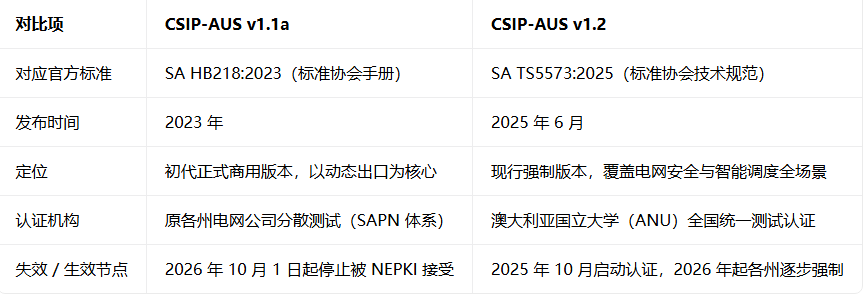
Three core technical upgrades
01 — Mandatory new EBM emergency stop mechanism
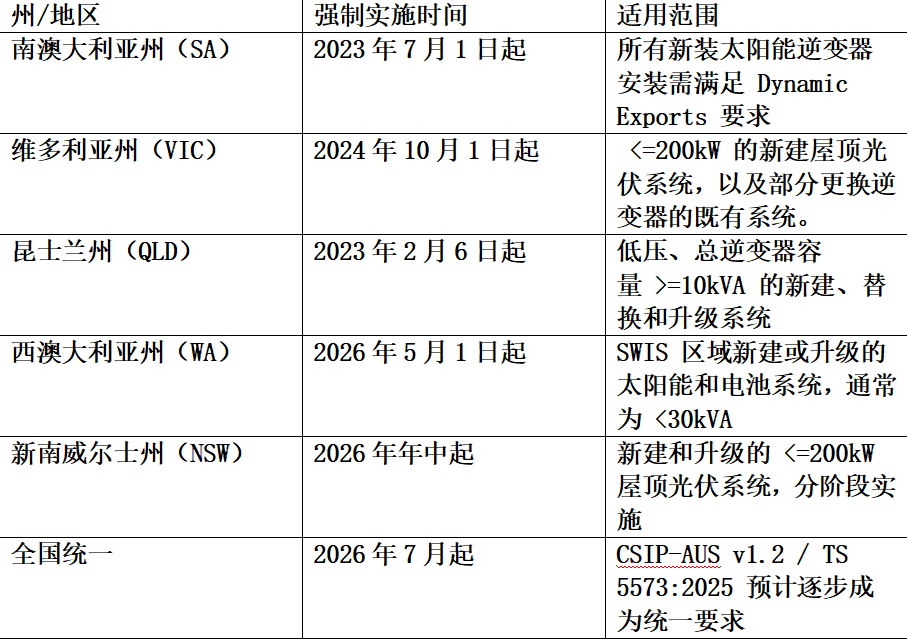
The most core mandatory requirement of CSIP-AUS v1.2. New South Wales (NSW) and the Australian Capital Territory (ACT) are phasing in CSIP-AUS-based EBM requirements, to be implemented progressively in the second half of 2026.
- EBM (Emergency Backstop Mechanism), introduced by the Australian Energy Market Operator (AEMO), is the last line of defense under extreme grid conditions — when photovoltaic output is extremely high and load extremely low, the grid can temporarily reduce or suspend distributed PV export through this mechanism, preventing abnormal system frequency and large-scale outages.
- v1.2: fully supports the complete EBM interaction flow, including command reception, power response, and status reporting, meeting grid security dispatch requirements.
- v1.1a: although v1.1a already offers some DER dynamic control capability, it cannot meet the new requirements for unified certification, testing, and secure access set by CSIP-AUS v1.2, SA TS 5573:2025, and NEPKI.
02 — Full binding of the NEPKI secure communication system
NEPKI is the Australian grid’s “identity card + encrypted channel” — the security foundation for trusted two-way communication between devices and the grid.
- v1.2: the certification process is deeply bound to NEPKI registration, requiring devices to implement a complete two-tier manufacturer-certificate and device-certificate system with encrypted, authenticated communication throughout, securing grid communication at the source.
- v1.1a: from October 1, 2026, NEPKI certificates tied to the old standard will no longer be recognized across Australian grids; devices cannot complete secure identity verification and directly lose grid-connection communication capability.
03 — Fully upgraded testing system and protocol compatibility
- Unified certification standard: ANU provides a nationally unified testing service on the CACTUS test platform, with more rigorous test cases and results recognized Australia-wide.
- Expanded test scenarios: TS5573:2025 adds many new test items covering DER dispatch, fault response, and virtual power plant (VPP) interaction, placing higher demands on communication stability and command response precision.
- Compatibility notes: v1.2 is backward compatible with v1.1a’s basic dynamic export functions, but new capabilities such as EBM and enhanced VPP dispatch are not backward compatible.
Key dates
Upgrade notes
- Not all products can transition through a firmware upgrade alone — some products whose hardware communication modules lack capability will need hardware changes to meet v1.2.
- Upgrade testing covers all new mandatory items; we recommend running internal pre-tests early to reduce the chance of rework in formal testing.
- After updating certification, confirm each state grid’s supported solutions list (SSL) in step to avoid affecting end customers’ grid-connection applications and subsidy claims.
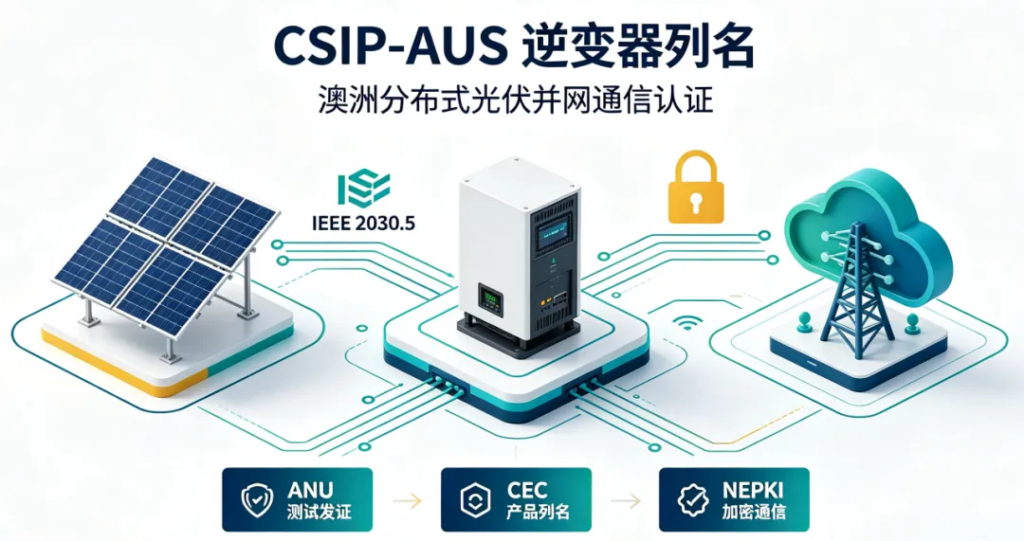
CSIP-AUS v1.2 is not an optional technical upgrade — it is the new-generation access threshold for Australia’s distributed energy market.
The October 1, 2026 deadline has no buffer period; products that fail to upgrade in time may face restricted access for new projects and impacted market entry for the products concerned.