
Global Market Access News — July 2026
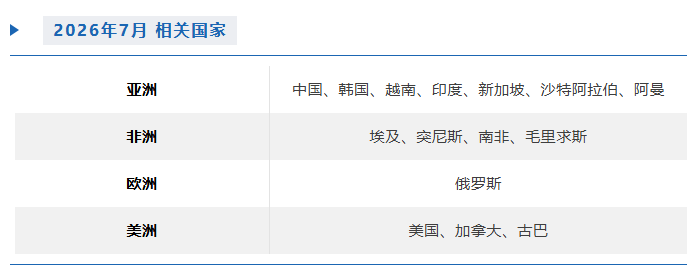
01 — Asia
China
On May 28, 2026, seven departments including the Ministry of Industry and Information Technology jointly issued the RoHS control catalog, and CCC certification standards for home appliances enter a mandatory version-change cycle
- MIIT and seven departments jointly issued the “Compliance Management Catalog for the Restriction of Hazardous Substances in Electrical and Electronic Products (2026 Edition)”, adding 23 controlled product categories to the existing 12, to be implemented on August 1, 2027.
- The EMC standard GB 4343.1-2024 becomes mandatory for new applications from June 1, 2026, and the safety standard GB/T 4706.1-2024 becomes mandatory from August 1, 2026; existing certificates must be converted by May 31, 2027 and July 31, 2027 respectively — past that, certificates face suspension up to revocation.
Original announcement: https://www.miit.gov.cn/zwgk/zcwj/wjfb/gg/art/2026/art_1abc7a6cb7d64e4e976cd454aa1df81e.html
South Korea
Korea’s National Radio Research Agency (RRA) issued Notice No. 2025-22 on December 31, 2025, revising the “Electromagnetic Wave Conformity Standards” — RF compliance requirements continue to tighten
- Adds broadband radiated immunity testing for the 3.4-3.7 GHz band with 5 test levels, performed per IEC 61000-4-41; the new rule took effect December 31, 2025 and is fully enforced from July 1, 2026.
Original announcement: https://www.rra.go.kr/ko/notice/noticeList_view.do?nb_seq=6299&cpage=1&nb_type=0
Vietnam
Multiple new rules updated in quick succession, the conformity assessment system fully restructured, and the mandatory cybersecurity standard for IP cameras lands
- The Ministry of Science and Technology issued Circular No. 14/2026/TT-BKHCN on April 9, 2026, effective May 25, 2026
- Draws the boundary between voluntary-standard declarations and mandatory technical-regulation declarations, matching differentiated assessment modes to product risk levels;
- Certificates are valid for up to 5 years, all applications must be submitted through the national online database, and the CR conformity mark is used uniformly.
- On June 15, 2026 the Ministry of Science and Technology issued a draft circular intended to replace Circular No. 29/2025/TT-BKHCN, adjusting WWAN technology products to a medium-low risk level requiring only a safety declaration of conformity; comments were due by July 16, 2026.
- The Ministry of Public Security issued Circular No. 48/2026/TT-BCA on May 12, 2026, formally implementing QCVN 11:2026/BCA, the “National Technical Specification for Internet-Protocol-Based Surveillance Cameras — Cybersecurity Baseline Requirements”, developed with reference to relevant EU ETSI standards.
Original texts of the regulations and standards: https://datafiles.chinhphu.vn/cpp/files/vbpq/2026/4/48-bca.pdf
https://mic.mediacdn.vn/document/2025/1/8/19tt-1736302773488908967988.pdf
India
Multiple updates to telecom standards and spectrum policy, with safety certification rules further refined
- India’s Department of Telecommunications (DoT) issued a notice on June 11, 2026, formally exempting short-range radar systems in the 77-81 GHz band from licensing requirements, simplifying market access for automotive millimeter-wave radar and industrial ranging radar.
- On April 16, 2026, the Wireless Planning and Coordination Wing (WPC) extended the compliance deadline for ETA re-certification of 5925-6425 MHz band equipment by three months, giving companies a certificate renewal window.
- On May 20, 2026, India’s Ministry of Electronics and Information Technology (MeitY) updated the series-application guidelines for IS/IEC 62368-1:2023, clarifying model-variation determination principles and setting quantitative criteria for differences in power supplies and critical safety components.
Original announcement: https://www.dot.gov.in/static/uploads/2026/03/dfb5fecb0467e2f52529cd4c0ff5dfd6.pdf
https://www.meity.gov.in/static/uploads/2026/05/39903ecbb6b343a149c2724e262ccf7b.pdf
Singapore
On June 9, 2026, Singapore’s National Environment Agency (NEA) issued new rules extending energy-efficiency regulation to imports for personal use, tightening compliance requirements for cross-border channels
- Extends the scope of the Minimum Energy Performance Standards (MEPS) and the Mandatory Energy Labelling Scheme (MELS) from commercial supply to imports for personal use, covering air conditioners, refrigerators, televisions, and other product categories.
- The new rules take effect on July 1, 2026; cross-border e-commerce direct mail, personal procurement, and similar channels all fall under regulation, and violating imports face fines of up to S$10,000.
Original announcement: https://www.parliament.gov.sg/api/media/b8c23bdb-cb5f-64e2-b198-ff00006af031/energy-conservation-(amendment)-bill-6-2026.pdf?sfvrsn=8c9d5f08_1
Saudi Arabia
In June 2026, the Saudi standards body SASO issued Circular No. 247, making supplier information a mandatory addition to product labels
- For products covered by 10 technical regulations, labels must clearly show the supplier’s name and corresponding commercial registration number, as a pre-review item for issuing certificates of conformity.
- The new rule is enforced from October 1, 2026 and covers e-scooters/e-balancers, child restraint systems, solar PV systems, and other products; SASO will conduct random checks through the SABER platform.
Original announcement: https://globalvalidity.com/wp-content/uploads/2026/06/saud-arabia-document.pdf
Oman
Mandatory GCTS certification for electric mobility devices enters full enforcement
- Electric scooters, balance boards, and other electric mobility devices, together with their batteries and chargers, are formally brought under mandatory GCTS certification; products must carry the GCTS traceability mark, and importers must submit a declaration of conformity for each batch.
- Fully enforced from April 30, 2026; products already on the market during the transition period may be sold until April 30, 2027.
02 — Africa
Egypt
Fully in use from January 1, 2026: a unified digital declaration system lands, and the Light Scheme certification scope is tightened
- The NTRA fully rolls out its unified digital type-approval declaration system; applications under all certification schemes must be submitted through the official digital platform, replacing the previous multi-channel declaration model.
- The scope of the Light Scheme is tightened: only products originating in highly regulated countries such as the EU and the US may use it; products made in China or India in principle require the intermediate or strict scheme. Pure 3G devices are no longer granted type approval.
Official sources: https://www.tra.gov.eg/ar/
https://digital.tra.gov.eg/Landing/service/T301
Tunisia
On May 5, 2026, Tunisia’s Telecommunications Research Centre (CERT) completed a national-level upgrade of its test laboratory, covering 5G and Wi-Fi 7 cellular testing platforms
- CERT completed the deployment of multi-technology wireless test infrastructure, equipped with 5G, Wi-Fi 7, and multi-standard cellular test platforms.
- After the upgrade it can independently complete
full-standard conformity testing across 2G/3G/4G/5G NR, LTE-M/NB-IoT, and Wi-Fi 6E/Wi-Fi 7, shortening certification timelines.
Official source: https://www.anritsu.com/en-gb/test-measurement/news/news-releases/2026/2026-05-05-gb01
South Africa
On May 22, 2026, South Africa’s Independent Communications Authority (ICASA) published “innovative spectrum” management regulations, formally landing the 6 GHz licence-exempt policy
- Designates 5925–6425 MHz (the lower 6 GHz band) as licence-exempt, available for compliant use by wireless service providers, private-network operators, and Wi-Fi deployments.
- The 3800–4200 MHz band is managed under a dynamic spectrum access framework; draft amendments to the spectrum regulations and fee regulations were published at the same time for public comment.
Official source: https://www.icasa.org.za/news/2026/icasa-publishes-draft-amendments-to-the-radio-frequency-spectrum-regulations-and-radio-frequency-spectrum-fees-regulations
Mauritius
On May 28, 2026, Mauritius’ Information and Communication Technology Authority (ICTA) announced the launch of a 3G network sunset plan
- Operators have begun retiring 3G base stations, and 3G mobile service will stop completely after 2028. The authority calls on importers to stop importing 3G-only terminal devices, guiding the market toward 4G LTE and 5G.
Official source: https://www.icta.mu/documents/2026/05/communique_sunsetting28May.pdf
03 — Europe
Russia
From February 2026, the Russian government strengthens its supervisory authority over EAEU cross-border conformity certificates; non-compliant certificates become invalid across the region
- The Russian government expands the supervisory powers of Rosaccreditation, which may suspend or revoke conformity certificates and declarations issued in violation by other EAEU member states.
- Where a member state’s certification body accumulates 3 violations within one year, all of its certificates become invalid in Russia for 12 months.
04 — Americas
United States
On June 15, 2026 the FCC issued Public Notice DA 26-588, easing controls on low-risk categories
- Formally removes “toy drones” meeting defined conditions from the controlled list.
- The exemption requires meeting multiple conditions at once on weight, flight parameters, and functional limits — including a maximum takeoff weight of ≤150 g, no positioning or network connectivity, no audio-visual perception modules — and the manufacturer must not be on the NDAA blacklist.
Original text of the notice: https://docs.fcc.gov/public/attachments/DA-26-588A1.pdf
Canada
Effective from January 16, 2026, Canada’s Innovation, Science and Economic Development (ISED) iterates the 2.3 GHz band wireless standard and updates technical rules for private-network equipment
- ISED issued two standards, RSS-195 Issue 3 and SRSP-516 Issue 2, adding technical requirements for wireless communication equipment in the 2305-2320 MHz and 2345-2360 MHz bands.
- With a six-month transition period, all new certification applications from July 16, 2026 must adopt Issue 3; SRSP-516 Issue 2 also adds deployment technical rules for active antenna systems.
Original text: https://ised-isde.canada.ca/site/spectrum-management-telecommunications/en/rss-195-wireless-communication-service-wcs-equipment-operating-bands-2305-2320-mhz-and-2345-2360-mhz
Cuba
Resolutions No. 1/2026 and No. 2/2026 of Cuba’s Ministry of Communications (MIC) took effect on January 8, 2026: new telecom equipment import rules are fully implemented, with tiered regulation of commercial and personal use
- Fully replaces the old regulations, strictly separating import requirements for commercial and non-commercial equipment.
- Telecom/radio products for commercial use require dual certificates — type approval plus technical authorization — valid for 5 years; test samples and personal-use devices are exempt from type approval but must apply in advance for temporary technical authorization.
- Local laboratory testing is required in principle; equipment such as high-frequency devices beyond local capability may be assessed on international reports; import of mobile phone signal boosters is prohibited, and devices with encryption functions require special evaluation.
Original text: https://www.gacetaoficial.gob.cu/sites/default/files/goc-2026-ex66.pdf