
On July 12, 2026, the Al-Bahah Chamber of Commerce and Industry (BCCI) and the Makhwah Chamber in Saudi Arabia simultaneously issued commercial notices formally announcing: the Saudi Standards, Metrology and Quality Organization (SASO) has decided to further postpone the implementation date of the mandatory standard SASO-2944:2023, “Technical Requirements for the Emergency Call (‘eCall’) in Motor Vehicles,” from the previously announced January 1, 2027 to January 1, 2028.
The mandatory requirement will apply to vehicle types of all categories.
This delay is directly good news for companies across China’s eCall supply chain. For Chinese manufacturers that already hold EU eCall (ECE R144) or UAE UAE.S 5019 certification experience, the extension provides a more comfortable window to prepare their market entry.
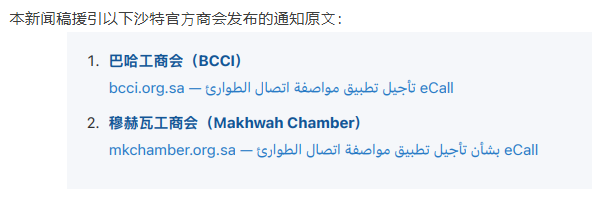
According to the notice published by the Saudi chambers, its core content is as follows:
• Urgent telegram from the Saudi Ministry of Commerce, No. 1582, dated 20 Muharram 1448 AH
• Citing an urgent telegram from the President of the Saudi Standards, Metrology and Quality Organization (SASO), No. 1/48000216, dated 16 Muharram 1448 AH
postponing the mandatory implementation of the standard SASO-2944:2023 (“Technical Requirements for the Emergency Call ‘eCall’ in Motor Vehicles”), which will apply to vehicle types of all categories from January 1, 2028 .
The notice was forwarded by the Federation of Saudi Chambers to the local chambers, and was released to their member companies by the Al-Bahah Chamber of Commerce and the Makhwah Chamber, among others, on July 12, 2026.
Background of the SASO-2944:2023 standard
Standard overview: SASO-2944:2023, in full “Technical Requirements for the Emergency Call (‘eCall’) in Motor Vehicles,” is issued by the Saudi Standards, Metrology and Quality Organization (SASO) and is a mandatory technical standard for the Saudi market.
The standard requires that light vehicles exported to Saudi Arabia be equipped with a compliant in-vehicle emergency call (eCall) system which, in the event of a severe crash, automatically or manually triggers an emergency call, transmits the minimum set of data (MSD) — including vehicle location, collision time, VIN, vehicle type, powertrain type, and more — to the Saudi emergency center (911), and establishes a voice call.
Version evolution and timeline
Key technical updates in the 2023 edition
- Mandatory 4G LTE communication: the eCall communication module must support 4G LTE networks; 2G/3G modules no longer meet the requirements;
- Small-volume exemption clause: low-volume models with an annual production/annual import volume of fewer than 75 units may apply for an exemption and are not required to install an in-vehicle eCall system;
- Refined technical requirements: clearer requirements are set for GNSS positioning accuracy (support for GPS, GLONASS, and other multi-constellation systems), compatibility with Saudi local mobile networks (SIM/eSIM must be compatible with local operators such as STC and Mobily), Arabic-language support in the human-machine interface, and the ability of the backup power supply to keep the system running after a crash.
Scope of application
Applicable vehicle types: light vehicles with a maximum gross weight (GVW) of no more than 3.5 tonnes, covering passenger cars, SUVs, MPVs, and light trucks, with no distinction between fuel and electric vehicles;
Exempted vehicle types: low-volume production models with an annual production/annual import volume below 75 units (formal application and approval required).
Notes and recommendations
1. Monitor follow-up developments closely: Saudi regulatory policy may be adjusted further; we recommend following subsequent announcements on the SASO official website.
2. Distinguish the applicable version: models already certified to SASO 2944:2020 may fall under a different version from new projects going forward; we recommend confirming the currently applicable version with SASO or a certification agency;
3. Plan localization early: the 4G communication module must be compatible with Saudi local operator networks, the SIM/eSIM must be issued by (or guaranteed compatible with) local operators, and the HMI must support Arabic — this localization work takes considerable time, so start as early as possible;
4. Note the difference from UAE.S 5019: Saudi SASO-2944 and the UAE’s UAE.S 5019 are two independent mandatory eCall certification systems; certificates are not mutually recognized, and each must be applied for separately.