
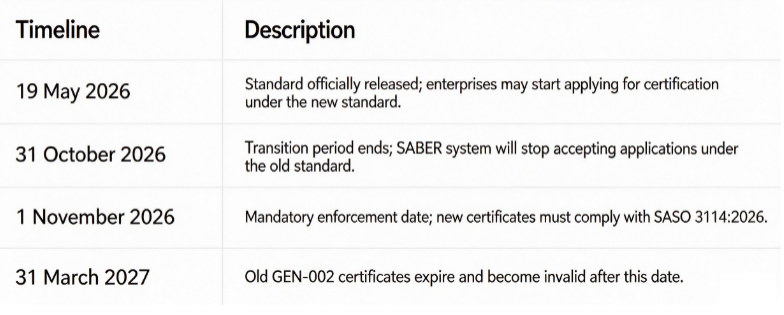
On May 19, 2026, the Saudi Standards, Metrology and Quality Organization (SASO) officially released SASO 3114:2026 Requirements for Specific Information and Communication Technology Equipment, replacing the SASO CITC GEN-002 General Technical Specification.
This standard will be officially enforced on November 1, 2026. All ICT equipment exported to Saudi Arabia must comply with the new technical requirements.
Timeline
Six Categories of Products Under Regulation
- Mobile phones (smartphones, feature phones)
- Tablet computers and mobile computers
- Mobile routers and Customer Premises Equipment (CPE)
- Other cellular-connected devices (IoT category): including cellular gateways, industrial routers, smart watches, POS terminals, etc.
- Optical Network Terminals (ONT) and Home Access Gateways (HAG)
- Wi-Fi distribution equipment (Mesh systems, repeaters, wireless APs, etc.)
Technical Requirements of the New Standard
General Basic Requirements
- 5-year system upgrade guarantee: Devices must provide at least 5 years of operating system and firmware upgrade support
- Mandatory cybersecurity requirements: Devices must be equipped with robust cybersecurity mechanisms, adopt unique authentication credentials per device, and prevent cyber attacks and unauthorized access
- Operator network compatibility: Mobile phones, mobile routers, and cellular CPE must pass network compatibility tests with local Saudi mobile operators;
Specific Requirements for Mobile Phones
- Cellular technology: Feature phones must support LTE bands B1/B3/B8/B20/B28; smartphones must additionally support 5G SA
- Network features: Wi-Fi 6 dual-band, VoWiFi, IPv4/IPv6 dual stack enabled by default
- Emergency communications: Smartphones are mandatorily required to support AML Advanced Mobile Location; all mobile phone categories must support CBS Cell Broadcast Service
- CBS detailed requirements: Emergency warning messages take priority over all device functions, support Arabic/English bilingualism, and are compatible with accessibility features
Tablets and Mobile Computers
- Cellular versions must support specified LTE bands and multi-system positioning
- Non-cellular versions must meet general technical requirements such as Wi-Fi dual-band support
IoT Cellular Devices
- Support at least one cellular technology among LTE, LTE-M, and NB-IoT, covering specified operating bands
- The network access layer must comply with the IP network specifications of Saudi CST; IPv6 protocol support has become a core technical indicator for IoT device network access approval
IoT Export to Saudi Arabia: IPv6 Testing is Key to Compliance
Within the SASO 3114:2026 compliance framework:
- IPv4/IPv6 dual stack enabled by default is mandatory for smartphones
- For network access devices such as cellular gateways, CPE, and IoT terminals, IPv6 protocol conformance and interoperability have become important technical bases for conformity assessment
- Having authoritative IPv6 test reports in advance can significantly improve the efficiency of SABER certification review and reduce the risk of supplementary testing and rectification