
For details on Australian CSIP-AUS certification, see the previous article “What is CSIP-AUS? A Full Breakdown of Australia’s Grid-Connection Communication Standard, Certification Mechanism, and Implementation Timeline”.
Next, let’s walk through the detailed test categories of Australian CSIP-AUS certification.
1. Test categories at a glance
CSIP-AUS certification tests are divided into three major categories with 13 subcategories in total:

2. Client category (communication protocol layer)
Client category tests focus on the correctness of the communication protocol layer, verifying whether the CSIP-AUS communication client (Software Communication Client, SCC) correctly implements each communication function according to IEEE 2030.5 and the CSIP-AUS specification.
All tests can be completed on the CACTUS self-test platform.
1. Category A
Official definition:
All clients that manage DER but do not claim demand response capability.
Interpretation:
- Category A is the most basic category of CSIP-AUS certification. As long as a client manages DER devices (whether generation, consumption, or storage) and does not claim to have demand response (DR) functionality, it falls within Category A.
- Category A is the mandatory gateway of certification — no matter which of the G, L, C, S, or M categories a client ultimately declares, it must pass Category A first.
Examples:
- A CSIP-AUS client managing a PV inverter
- A CSIP-AUS client managing a storage inverter
- A CSIP-AUS client managing an EV charging station
- A CSIP-AUS client acting as a communication gateway managing multiple DER devices
- The CSIP-AUS client in a VPP aggregation controller
2. Category G
Official definition:
Clients that manage generation-type or storage-type DER
Interpretation:
- As long as the managed DER has generation or storage functionality, its client falls under Category G.
- Building on Category A, Category G verifies the communication capability the client needs to manage such devices.
Examples:
- A CSIP-AUS client managing a PV inverter
- A CSIP-AUS client managing a storage inverter (generation direction)
- A CSIP-AUS client managing a wind power controller
3. Category L
Official definition:
Clients that manage load-type or storage-type DER.
Interpretation:
- As long as the managed DER has consumption/load functionality or storage functionality, its client falls under Category L.
- Note that storage-type DER appears in the definitions of both Category G and Category L, because storage involves both generation (discharge direction, governed by Category G) and consumption (charging direction, governed by Category L).
- Building on Category A, Category L verifies the communication capability the client needs to manage such devices.
Examples:
- A CSIP-AUS client managing an EV charger
- A CSIP-AUS client managing storage equipment with consumption capability (charging side)
- A CSIP-AUS client managing other controllable load-type DER
4. Category C
Official definition:
Clients conforming to the optional ConnectionPoint extension.
Interpretation:
- Category C targets clients implementing the ConnectionPoint extension. Its purpose is to submit the LFDI together with the connection point reference (usually the site NMI) to the utility server via the CSIP-AUS connection point extensions during the in-band registration process. Whether Category C is needed should be determined by the access requirements of the target utility server / DNSP, not by device type alone.
- Building on Category A, Category C verifies whether the client correctly implements the registration flow of this extension.
5. Category S
Official definition:
Clients implementing subscription/notification functionality.
Interpretation:
- This is the Pub-Sub mechanism of IEEE 2030.5: the client can subscribe to changes in resources of interest on the server, and when a resource changes the server proactively pushes a notification to the client, replacing traditional polling.
- Category S is optional; a client may skip this function and still pass certification in the other categories.
Examples:
- The CSIP-AUS client in a VPP aggregation controller
- A communication gateway CSIP-AUS client managing large-scale DER clusters
- A storage system CSIP-AUS client that must respond to grid dispatch events in real time
6. Category M
Official definition:
Clients supporting management of a DER aggregation.
Interpretation:
- “Aggregation” means one client manages multiple DER devices simultaneously (at least 2), rather than a single device.
- Building on Category A, Category M verifies whether the client can register, dispatch, and monitor multiple DER devices simultaneously.
- Category M is an additional test item. According to the v1.2 manual published by ANU in January 2026, the Category M test is usually performed only once, and a pass is attached to the relevant certification records before and after; subsequent practice should still follow ANU’s latest certification rules.
Examples:
- A communication gateway CSIP-AUS client managing multiple PV inverters
- The CSIP-AUS client in a home energy management system (HEMS)
- The central controller CSIP-AUS client of a commercial/industrial multi-unit parallel inverter system
3. DER-Client Pair category (physical response layer)
DER-Client Pair category tests go one step beyond the Client category: the DER physical device is paired with the client, and end-to-end physical behavior is verified in a real or highly simulated grid environment.
These tests must be witnessed by ANU to verify the physical response of the client-device pairing; they are not a pure self-test process.
1. DER-A category
Official definition:
All DER.
Interpretation:
- The DER-A category is the general foundational category of the DER-Client Pair layer. “All DER” means that regardless of whether the device is generation-type, load-type, or storage-type, any device participating in DER-Client Pair layer testing must pass DER-A.
- It verifies the end-to-end baseline behavior of the client-DER pairing in a real physical environment, corresponding to Category A of the Client layer — Category A verifies the communication protocol, while DER-A verifies the physical pairing.
Examples:
- A PV inverter + CSIP-AUS client pairing
- An EV charging station + CSIP-AUS client pairing
- A storage system + CSIP-AUS client pairing
2. DER-G category
Official definition:
All DER with generation capability.
Interpretation:
- “All” means no limitation to specific types — PV, storage (discharge direction), wind, and any other DER that can generate power must pass DER-G in its client-DER pairing.
- In a real physical environment it verifies the end-to-end behavior of generation-type DER paired with the client, and is the physical verification of the DER-Client Pair layer corresponding to Category G of the Client layer.
Examples:
- A PV inverter + CSIP-AUS client pairing
- A storage inverter (generation direction) + CSIP-AUS client pairing
3. DER-L category
Official definition:
All DER with consumption capability.
Interpretation:
- “All” means no limitation to specific types — load devices, storage (charging direction), EV charging stations, and any other DER that can consume power must pass DER-L in its client-DER pairing.
- It verifies the end-to-end behavior of consumption-type DER paired with the client in a real physical environment, and is the physical verification of the DER-Client Pair layer corresponding to Category L of the Client layer.
Examples:
- An EV charging station + CSIP-AUS client pairing
4. DRED-Client Pair category (demand response layer)
DRED-Client Pair category tests are the highest and least used test tier of CSIP-AUS certification, performing dedicated verification for specific demand response (DR) scenarios.
The DRED-Client Pair category is used for dedicated testing of DRED or electrical products with demand response capability. According to ANU’s v1.2 manual of January 2026, the DRED path is not yet widely used, and ANU has explicitly stated it has not yet seen any client or server actually using these categories.
From current public practice, the mainstream certification paths for Flexible Exports and Emergency Backstop usually still rely mainly on the DER category tests. The vast majority of devices that only need to support Flexible Exports or Emergency Backstop do not need any category in this section. Client category tests focus on the correctness of the communication protocol layer, verifying whether the CSIP-AUS communication client (Software Communication Client, SCC) correctly implements each communication function according to IEEE 2030.5 and the CSIP-AUS specification.
1. DR-A category
Official definition:
All clients that manage demand response devices (including DRED or electrical products with demand response capability).
Interpretation:
- The DR-A category is the foundational category of the DRED-Client Pair layer. “All clients” means that any client entering the demand response verification route, whether it manages a DRED (dedicated demand response enabling device) or an electrical product with built-in demand response capability, must pass DR-A first.
- Building on DER-A, it verifies the end-to-end behavior of the client-DER pairing in demand response scenarios.
Examples:
- A PV inverter + CSIP-AUS client pairing participating in a DNSP demand response program
- A storage system + CSIP-AUS client pairing participating in a DNSP demand response program
2. DR-D category
Official definition:
Clients that manage or are integrated into DRED demand response devices and are not part of an electrical product.
Interpretation:
- The DR-D category targets clients that manage or are integrated into a DRED (demand response enabling device) and are not part of any electrical product.
- The key distinction is “not part of an electrical product” — that is, it is a standalone dedicated demand response controller, not a communication module embedded inside an electrical product such as an inverter or charging station.
- Building on DR-A, DR-D verifies the end-to-end demand response behavior of such standalone DRED clients.
Examples:
- A smart load + CSIP-AUS client pairing participating in a distributed demand response program
- A storage system with local decision-making capability + CSIP-AUS client pairing
3. DR-L category
Official definition:
Clients that manage load-type or storage-type electrical products with demand response capability.
Interpretation:
- The DR-L category targets clients that manage load-type or storage-type electrical products with demand response capability. Unlike DR-D (standalone DRED), DR-L addresses demand response capability embedded in an electrical product.
- Building on DR-A and DER-L, DR-L verifies the end-to-end behavior of such electrical products in demand response scenarios.
Examples:
- An industrial load + CSIP-AUS client pairing participating in wholesale-market DR
- A commercial building load management system + CSIP-AUS client pairing participating in wholesale-market DR
4. DR-G category
Official definition:
Clients that manage generation-type or storage-type electrical products with demand response capability.
Interpretation:
- The DR-G category targets clients that manage generation-type or storage-type electrical products with demand response capability. Unlike DR-D (standalone DRED), DR-G addresses demand response capability embedded in an electrical product.
- Building on DR-A and DER-G, DR-G verifies the end-to-end behavior of such electrical products in demand response scenarios.
Examples:
- A storage system + CSIP-AUS client pairing participating in the frequency regulation market
- A generation aggregation device in a VPP + CSIP-AUS client pairing
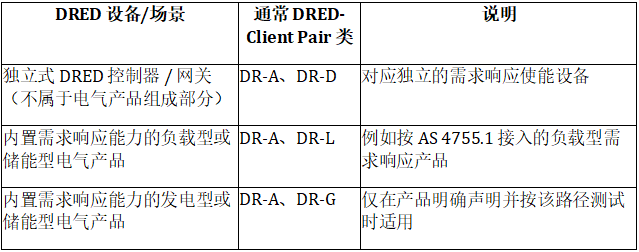
5. Device type quick-reference table
If the device explicitly adopts the DRED / AS 4755.1 demand response path, it is usually understood as follows:
An important clarification:
For the device types most common in Australian grid connection today — PV inverters, storage systems, and EV charging equipment — if the primary goal is to meet requirements such as Flexible Exports, Dynamic Operating Envelopes (DOE), or Emergency Backstop, they should usually first be understood from the DER path, not by default placed into DRED category tests.
Only when the device or project explicitly requires the DRED / AS 4755.1 demand response path is it necessary to further evaluate DR-A, DR-D, DR-L, or DR-G.